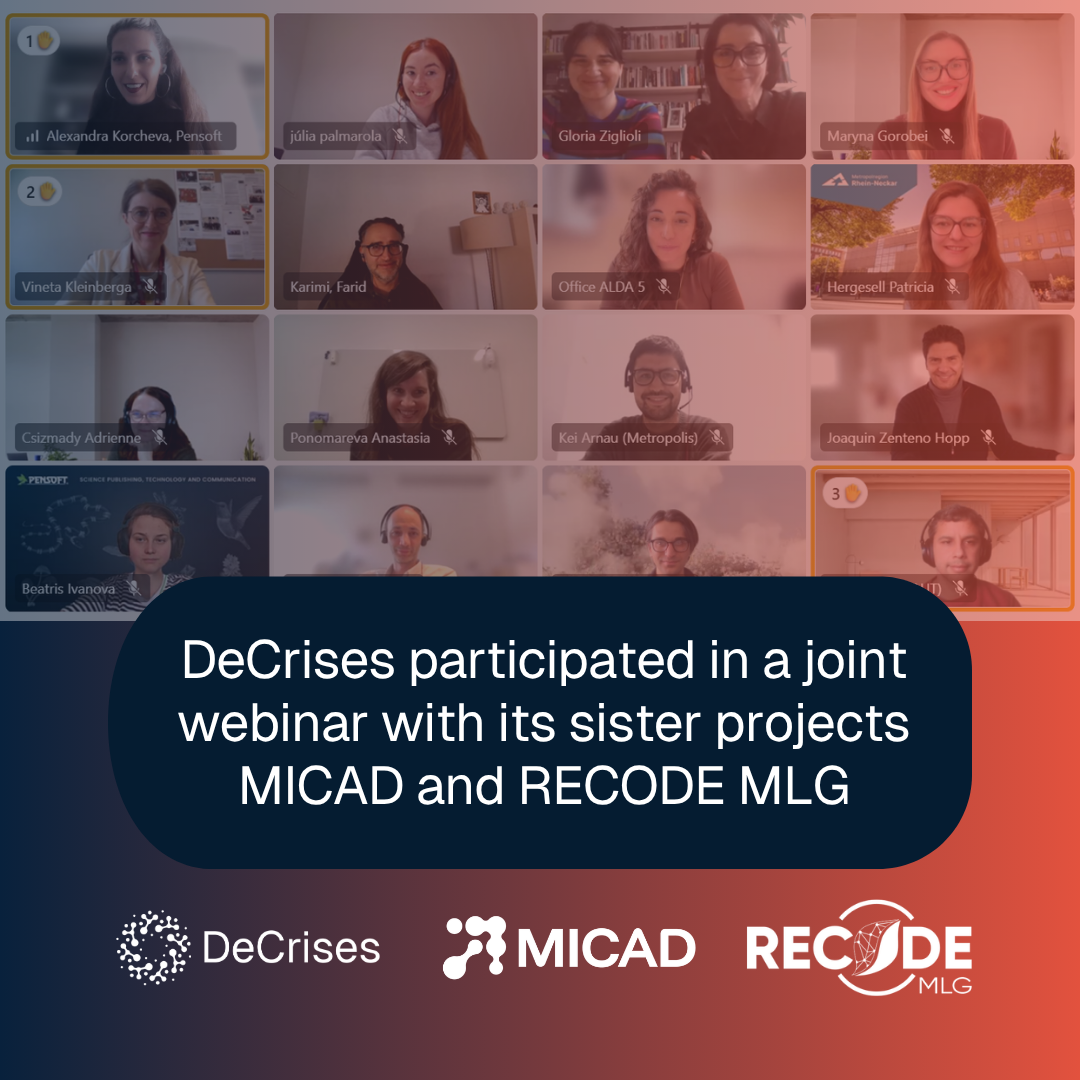
Image: DeCrises participated in a joint webinar with its sister projects.
Credit: Pensoft Publishers
DeCrises participated in a joint webinar with its sister projects MICAD and RECODE-MLG
On 14 April 2026, a total of 44 members of the three sister projects DeCrises, MICAD and RECODE-MLG participated in a joint webinar to present their work and discuss future collaborations between these three initiatives.
The webinar began with opening remarks from Dr. Farid Karimi, the DeCrises project’s coordinator, who facilitated this meeting.
Then, the three projects were presented, with the first presentation focused on DeCrises’ mission to identify and address the institutional gaps in current multilevel governance (MLG) systems and promote citizen-driven approaches that empower communities in the EU. The work package (WP) leaders of DeCrises introduced their work, their goals and how they plan to achieve them.
During the next presentation, participants learned more about RECODE-MLG’s goal to promote a just, inclusive and democratic twin transition, by advancing actionable knowledge of co-creation to help policymakers at all levels develop and implement effective, legitimate and better informed policy within the MLG system of the EU. Three main objectives were in the spotlight:
- assessment of the MLG of the twin transition;
- innovation of scientific models and practice of co-creation through four “co-creation labs”;
- generation of a set of policy recommendations, a practical co-creation manual and a documentary film.
The third presentation introduced MICAD and its goal to create a robust framework for inclusive metropolitan co-planning, focusing on climate and digital transitions globally, with a specific focus on Europe. The presenters highlighted the main phases of this process including:
- research and knowledge gathering through Living Labs - real-life spaces where citizens, policymakers and businesses co-create and test solutions;
- adaptation and learning through Operational Hubs and collaborative training sessions;
- development and application through a Roadmap for digital or climate transition created by each metropolitan area;
- replication and sustainability through policy recommendations for European and national institutions.
These three presentations were followed by a Q&A session, during which the participants shared more details and insights from each project.
The next item on the event’s agenda was presenting the future plans of these projects including participating in high-impact events, organising joint workshops, exchanging research findings and more.
Finally, the webinar concluded with a discussion on future collaborations between these three sister initiatives based on the exchanged information during this meeting.
Stay tuned for more synergies between the three projects!