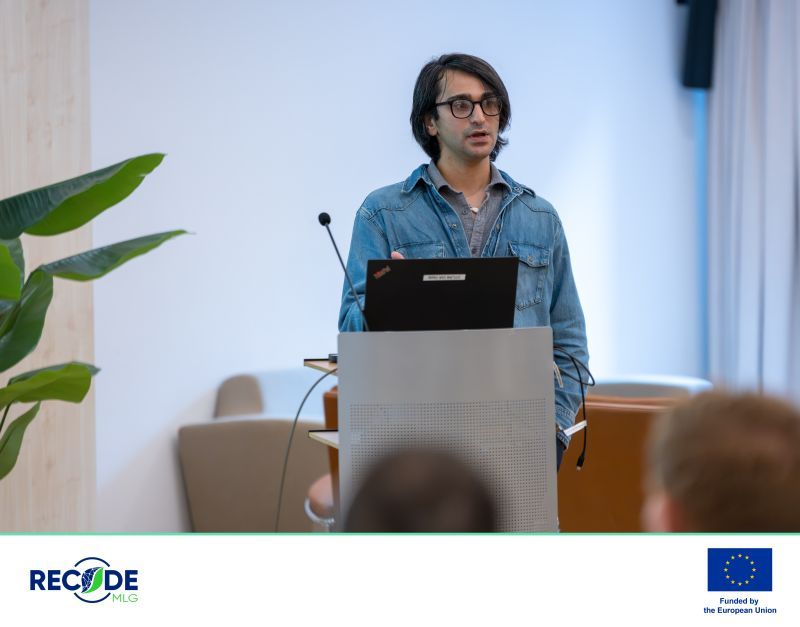
Photo: Giga Mukutadze at the workshop “Twin Transition - Making It Work in Europe’s Cities and Regions”
Credit: RECODE-MLG
DeCrises Project Presented at a Twin Transition Workshop in Brussels
On 14 October 2026, the workshop “Twin Transition - Making It Work in Europe’s Cities and Regions” was held at the Norway House in Brussels, Belgium. Together with other distinguished guests, the workshop brought together representatives of the Horizon Europe projects DeCrises, MICAD and RECODE-MLG to discuss governance challenges and opportunities related to Europe’s twin transition.
During this workshop, Giga Mukutadze, a doctoral researcher at the University of Jyväskylä (JYU), presented findings from the DeCrises project. His presentation highlighted the crucial role of local and regional authorities in ensuring a successful and socially just green transition. Although local governments are often the level of governance closest to citizens, their influence on EU policymaking remains uneven across Member States. As explained in this presentation, experts identify several challenges, including limited consultation, capacity constraints, funding barriers, and communication gaps between EU institutions and local implementers.
Moreover, this presentation discussed recommendations for strengthening multilevel governance. These included improving dialogue between levels of government, enhancing the participation of local and regional authorities in decision-making, and providing the resources needed to implement Green Deal objectives effectively.
This discussion underscored that stronger multilevel governance and meaningful stakeholder participation are essential for delivering a democratic, inclusive, and effective green transition across Europe.
Read more about this workshop here.