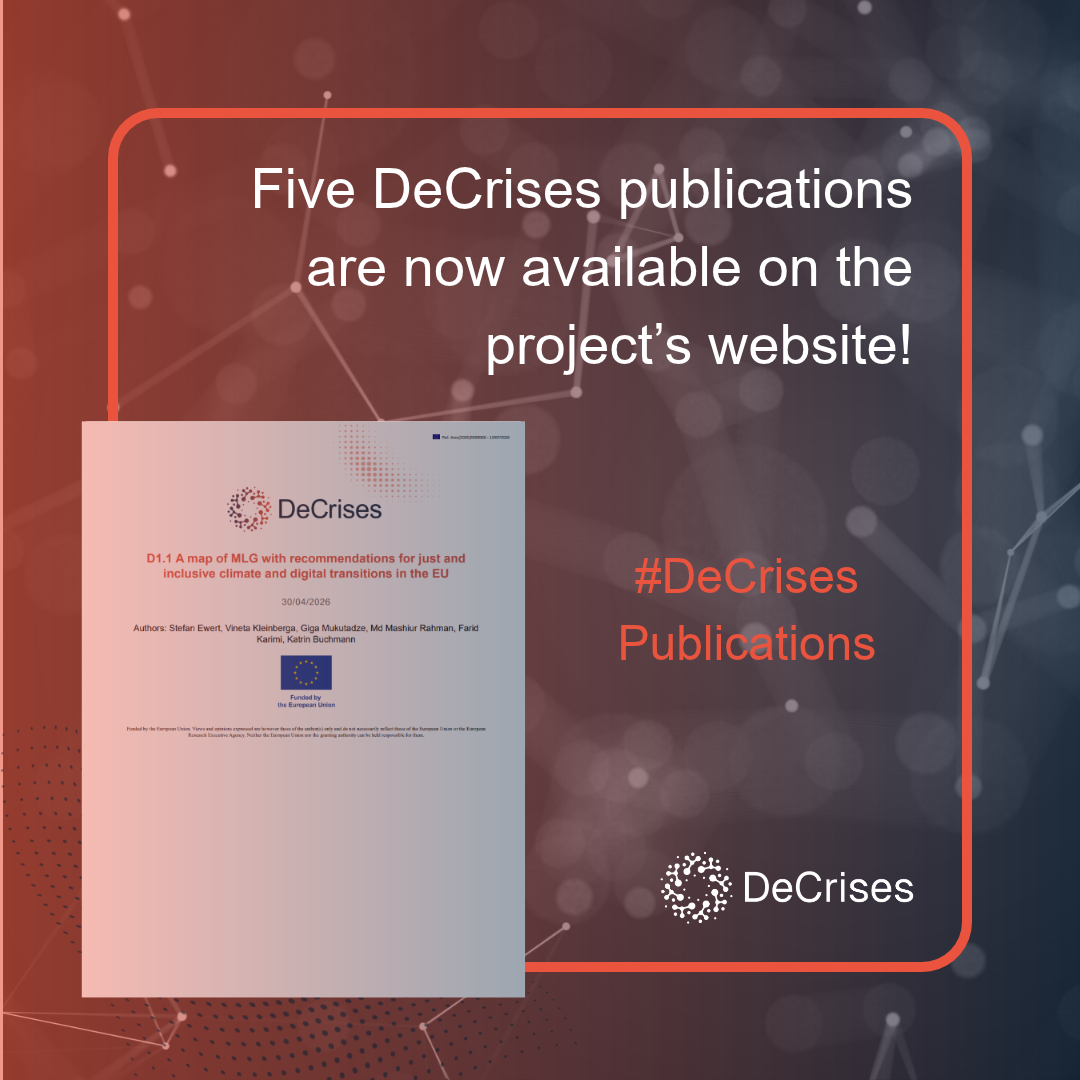
Image: Five DeCrises publications are now available on the project's website!
Credit: Pensoft Publishers
Mapping where Europe’s twin transition governance works and where it comes under strain
How do European climate and digital policies travel from EU-level ambition to action in countries, regions, municipalities and communities? A new DeCrises deliverable maps the multilevel governance (MLG) structures shaping the twin transition in Finland, Latvia, Norway and Poland, and identifies recurring points at which coordination, capacity and participation can break down.
This DeCrises Deliverable 1.1 examines eight governance settings: climate and digitalisation in each of the four countries. Using a common analytical grid, it traces strategic agenda-setting, decision-making and legal authority, policy instruments and incentives, implementation capacity, coordination, participation and inclusion. It also treats infringement proceedings as more than isolated legal problems: they can reveal systemic governance stress, including failures of coordination, insufficient administrative capacity, political blockages and weak connections between policy design and local implementation realities.
The comparison shows that similar compliance problems can have very different causes. In Finland, strong administrative capacity coexists with constitutional complexity, uneven consultation and subnational capacity constraints. Latvia’s governance challenges are closely linked to institutional fragmentation and limited capacity. Norway must implement significant elements of EU policy through the EEA without voting rights in EU lawmaking, while municipalities face funding and implementation gaps. In Poland, climate governance is shaped by coal dependency and contested political ownership, while digital governance is affected by the independence and stability of regulatory institutions.
Across these cases, the document highlights a persistent gap between decisions made at higher levels and the actors expected to implement or live with their consequences. Yet it also identifies openings for change: consequential consultation, local experimentation, citizen-centred digital governance, community energy, cross-level coordination and stronger roles for municipalities and civil society.
By making these governance relationships visible, the report provides an empirical foundation for identifying where public deliberation, bottom-up engagement and social innovation could make Europe’s climate and digital transitions more just, inclusive and effective.
Read the full document here.