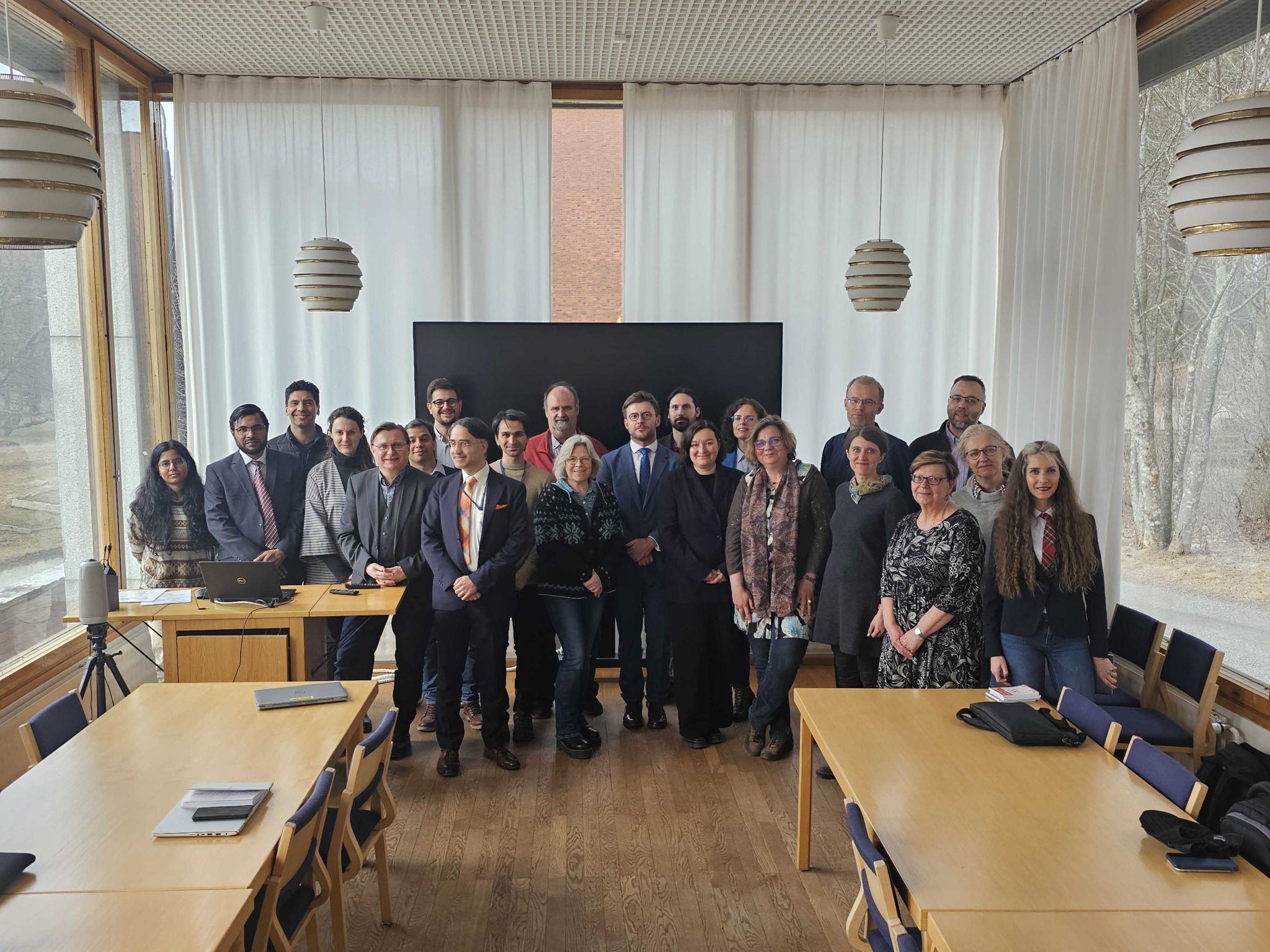
Image: DeCrises at the NEEDS 2026 Conference
Photo credit: Faculty of Social Sciences, Arts and Humanities, Kaunas University of Technology - NEEDS 2026 Conference
"Societal Resilience in Times of Cascading Crises and Disasters": DeCrises at the NEEDS 2026 Conference
On 28-30 April, the Kaunas University of Technology (KTU) became a hub of intellectual exchange as the NEEDS 2026 Conference unfolded, bringing together a dedicated community of scholars and practitioners to confront the era of "cascading crises". The DeCrises project team actively steered the dialogue toward an equitable twin transition and more inclusive governance.
The conference opened with a powerful sense of synergy. Prof. Aistė Balžekienė (KTU), serving as the Chair of the NEEDS 2026 Committee, welcomed a global audience of researchers and practitioners who share the concerns of disaster and emergency management. Dr. Farid Karimi (JYU), the DeCrises Project Coordinator shared a vision that in an interconnected world where small local disruptions can spark global challenges, resilience must be built through social innovation and community empowerment.
As the first day progressed, the DeCrises team began weaving together the technical and human threads of resilience. Vineta Kleinberga (RSU) opened discussions on the institutional frameworks necessary for "resilient futures," while Asta Jurgutė (KTU) led sessions on how technological innovation can be harnessed for disaster reduction. However, the conversation quickly shifted to the often-overlooked human element. Dr. Joaquin Zenteno Hopp (WNRI) delivered a presentation on "invisible voices," arguing that socio-technical change is frequently stalled by personal barriers and the exclusion of marginalized perspectives.
The narrative deepened on the second day, moving from general governance to inclusive solutions. Natalia Bełdyga (KTU) moderated vital discussions on refugee integration, later joining a roundtable to champion "The Power from Below," emphasizing that grassroots organizing is essential when formal systems are under strain. Nearby, Prof. Audronė Telešienė (KTU) and Matúš Mišík (UNIBA) were chairing sessions on community health and preparedness frameworks, ensuring that societal readiness was viewed as a holistic endeavor.
The centerpiece of the event was the DeCrises-led roundtable moderated by Dr. Farid Karimi. This session brought together DeCrises project experts - including A. Balžekienė, M. Mišík, J. Zenteno Hopp, V. Kleinberga and P. Arteaga - to tackle the challenges of multilevel governance (MLG). They spoke of a world shifting from "green politics" to "security politics," emphasizing that decarbonization must remain just and energy must stay affordable for the transition to succeed. The panel argued that local communities should be more than participants; they must be co-owners of resilience projects, with civil society acting as watchdogs to ensure accountability.
The final day brought these concepts into the spotlight through empirical research and interactive experiences. Prof. Aistė Balžekienė presented her findings on how differently experts and laypeople in Lithuania perceive crisis preparedness, highlighting the critical role of trust. Dr. Matti Kojo (LUT) explored how deliberative panels could engage the public in complex projects like nuclear energy, while Dr. Farid Karimi chaired a final look at the politics of democratic resilience. To bring the theory to life, Prof. Audronė Telešienė led an intensive simulation, forcing participants to navigate a complex environment of cascading risks in real-time.
Throughout these sessions, the DeCrises team emphasized that resilience is not just about technology, but about social innovation that could contribute to disaster prevention, efficient response in crises situations and speedy recovery. Key takeaways from their discussions included the need for civil society to act as watchdogs, the importance of local communities being co-owners of transition projects, and the critical requirement for better coordination between stakeholders to address institutional gaps in governance.
As the conference drew to a close, the message from the DeCrises team was clear: building a resilient Europe requires more than just new policy - it requires a fundamental shift toward social innovation and a commitment to ensuring that, in the face of any disaster, no community is left behind.